This week I wanted to tell you about my online store, Good Sensory Learning. I’m Dr. Erica Warren, and I established this site so I could share all the materials that I have created over the last 20+ years as a learning specialist and educational therapist. When I first began my private practice, Learning to Learn, I had great difficulty finding fun and multisensory materials for my students that were effective and engaging. So back in 2005, I made it my mission to design and distribute high-end, remedial products as well as memorable, motivating lessons that bring delight to learning. If you would like to try a free sampling of my activities , CLICK HERE . How Are the Products Organized at Good Sensory Learning? You can download my Free Printable Catalog or you can browse the site using the grey “search all products” bar in the top right of any page with keywords such as dyslexia, working memory, and executive functioning. What’s more, drop down menus in the red banner allow you t...
The brain is much like the body. If we exercise areas that are weak or underdeveloped, we can overcome significant difficulties. In fact, we may even be able to turn a weakness into a strength. Just like a personal trainer or physical therapist can strengthen an underdeveloped bicep or repair a sprained ankle, a learning specialist or educational therapist can remediate troublesome cognitive processing areas like visual processing or auditory memory. In fact, I often tell my students that I'm a personal trainer for the brain.
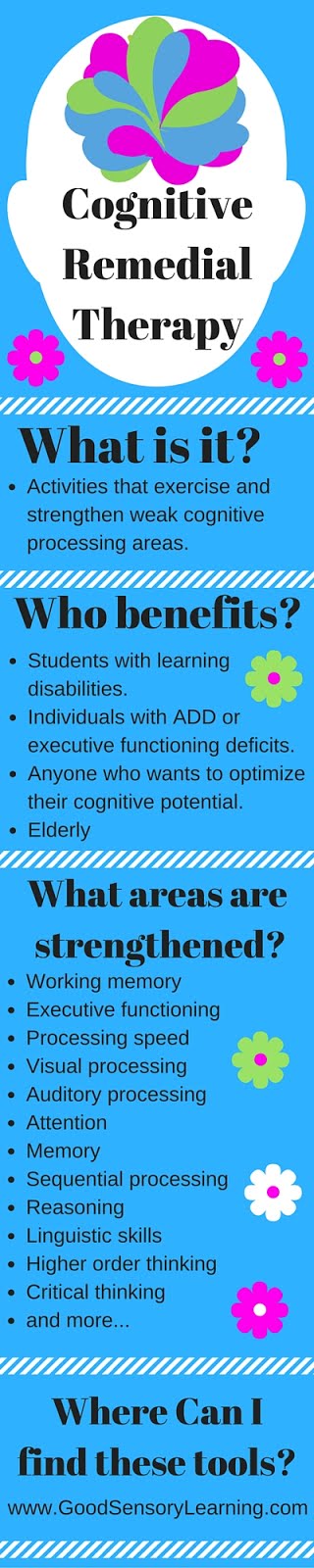
Cognitive remedial therapy involves activities that improve mental abilities such as attention, working memory, reasoning, visual and auditory processing, cognitive flexibility, processing speed, stamina, organizational skills, time management and more. In addition, educational therapists and learning specialists can use activities to strengthen other areas of weak cognition such as language, as well as visual and auditory processing. This form of remediation offers a wide range of intensive interventions designed to address and eliminate learning problems. This intervention is individualized for each learner.
How Can Cognitive Remedial Therapy Help Students with Learning Disabilities?
Cognitive remedial therapy helps to strengthen weak areas of cognition through focused activities that target areas of weakness or deficit. Activities begin at the individual student's level and increase in difficulty as the individual experiences success. The key is keeping the individual in their zone of proximal development, which is an instructional area between the actual developmental level as determined by independent problem solving and the level of potential development as determined through solving problems with guidance. When remediation focuses intensely on one area of cognition, measurable gains can be significant.
What are the Common Key Areas that Students with Learning Disabilities Need to Strengthen?
Every student with learning disabilities has their own unique profile, but the following offers a list of some common areas of deficit:
- Working memory
- Executive functioning
- Processing speed
- Visual processing
- Auditory processing
- Attention
- Memory
- Sequential processing
- Reasoning
- Linguistic skills
- Higher order thinking
- Critical thinking
As no two people with learning disabilities are alike, be sure to use a tailored approach that can meet the unique needs of each individual student. If you are looking for cognitive remedial tools, there is a great selection of options at Good Sensory Learning.
I also offer a monthly newsletter that features my current projects and publications, freebies, sales at Good Sensory Learning and my Amazon store, a summary of my most recent blogs and more. Sign up below! What's more, I will be creating an online support platform and course for creating successful learning specialist and educational therapist practices. If you want to be kept abreast of this project, be sure to sign up for my project newsletter that will be offering freebies and unique opportunities. See below.
Cheers, Dr. Erica Warren
Dr. Erica Warren is the author, illustrator, and publisher of multisensory educational materials at Good Sensory Learning and Dyslexia Materials. She is also the director of Learning to Learn and Learning Specialist Courses.
· Blog: https://learningspecialistmaterials.blogspot.com/
· YouTube Channel: https://www.youtube.com/user/warrenerica1
· Podcast: https://godyslexia.com/
· Store: http://www.Goodsensorylearning.com/ & www.dyslexiamaterials.com
· Courses: http://www.learningspecialistcourses.com/
· Newsletter Sign-up: https://app.convertkit.com/landing_pages/69400

· Blog: https://learningspecialistmaterials.blogspot.com/
· YouTube Channel: https://www.youtube.com/user/warrenerica1
· Podcast: https://godyslexia.com/
· Store: http://www.Goodsensorylearning.com/ & www.dyslexiamaterials.com
· Courses: http://www.learningspecialistcourses.com/
· Newsletter Sign-up: https://app.convertkit.com/landing_pages/69400
Comments
Post a Comment